Blog Goodbye Canny
In 2024, I migrated from UserVoice to Canny for user feedback collection. This move followed the UserVoice turn to enterprise clients and their removal of free & small plans. UserVoice still offerred me a hidden plan for a small fee after discussion with the support (something like $39 or $49/month as I recall), but who knows when they were gonna kill it, it's never a good idea to rely long-term on a hidden plan. And seeing the trajectory the company was taking (enterprise & hidden pricing), and how the UI was still very poor, I decided it was finally time to jump ship.
After a lot of comparison (and time spent testing and migrating), I was happy with the change as Canny provided a much better UI, and also at their pricing at the time — Canny is known for changing prices regularly and quite drastically — meant I was able to stay in the just announced free plan 🎉 (I was happy to pay a small fee if needed but that was not required). I knew after 5 price changes already it was only a matter of time before they change it again and I have to pay something, but I hoped it would be late and/or not too expensive (you see where I'm going).
Fast forward 2 years and the obviously expected 6th pricing change is announced 🙄. They are obviously greatly reducing the generous free plan to push people into paying plan, which is fair and I was ready to pay something for it (especially as I already had a 2 year "credit" of free service). But I was not ready for this:
New plan: core
Plan price before discount: $311/month ( $249/month on a yearly plan)
Discount: 30% discount if you upgrade before the end of November.
(6-month discount for monthly plans, 12-month discount for annual plans)
Going from 0 to $311/month is quite a steep increase 😲, for a service on which I have a few comments per months on ~85 open user suggestions. I noticed this new "core" plan had a $19/m call price (paid annually, $24 monthly), but for me it was $311 monthly.
By the way: 6-month and 12-month discounts are a joke to me, as it's just a way to temporarily lure you in. When I make a decision I think about the next 10-20 years, so it's negligible.
That is more than half of the entire updown.io infrastructure cost for comparison (14 servers at the time). Hard to justify for a glorified forum.
The trick they pulled here is by making the price scale on the number of "tracked users":
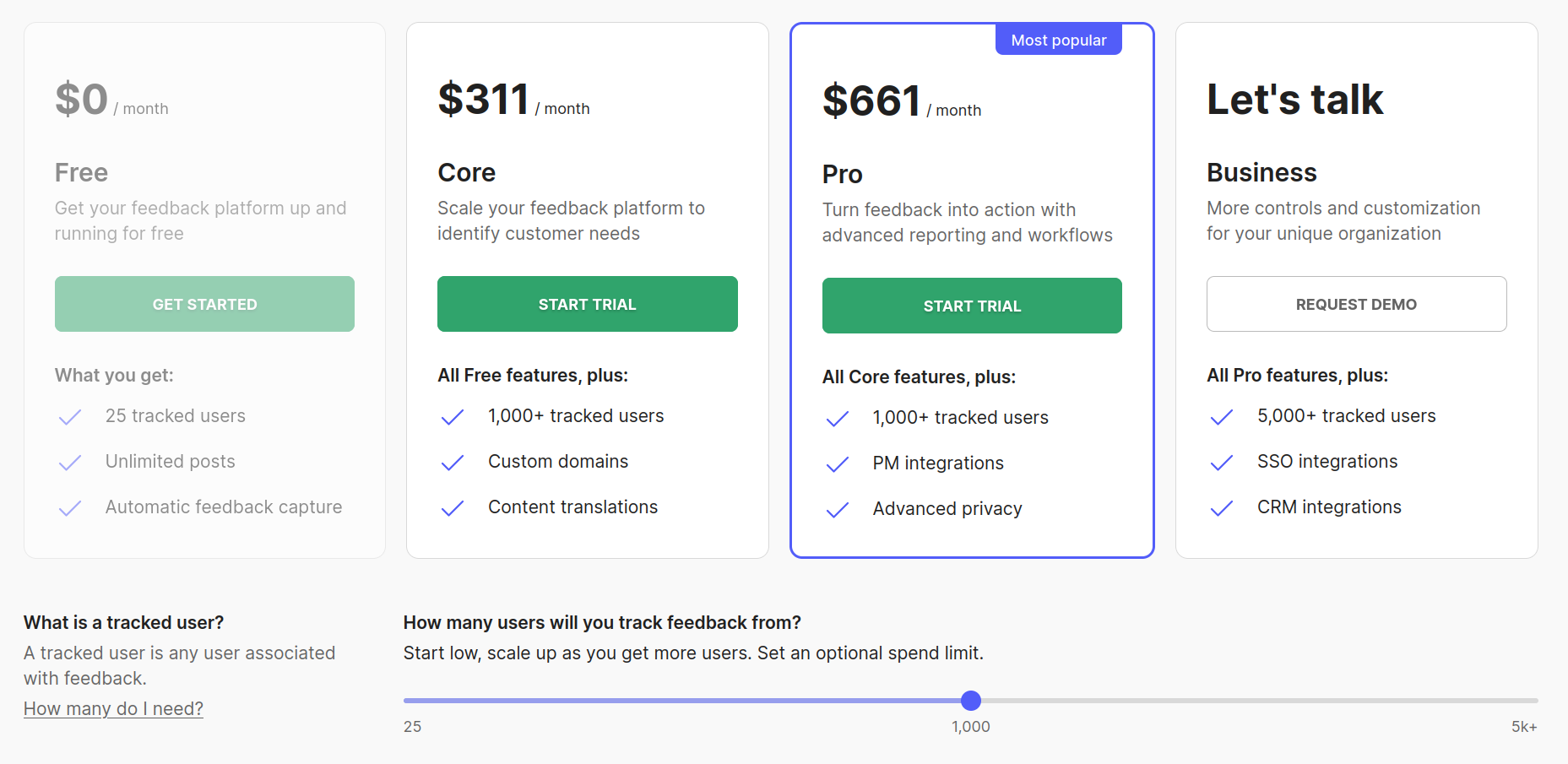
It's quite funny because this is exactly what they removed in 2024, saying:
Goodbye Tracked User Limits
Our plans have always included a set number of tracked users. Extra tracked users were available for a fee. Tracked users were our value metric.
This worked ok, but it introduced unpredictability. What percent of your users are going to leave feedback? What if a major release or outage triggers a surge of feedback? In either case, you could exceed your tracked user limit.
To make our pricing more predictable, we’re removing tracked user limits altogether. All plans, including the Free plan, now include unlimited tracked users.
So in 2024 they started tracking active feedback instead (and the number of admin accounts), meaning the number of feedback that were not closed or completed. The free plan was limited to 100 of those, and it was quite easy for a small service like me to keep it under 100 if needed by doing a bit of cleanup (that was rarely needed in my case considering the few number of new feedback I receive). This number has the advantage (for us the clients) of being quite stable and predictable, bigger companies will have more but overtime it should be rather stable as the feedback you close, complete or delete balance out the new ones.
On the other hand, the number of "tracked users" they defined as: "any user associated with feedback", counts almost all users, even if the feedback is closed or completed 10 years ago. That's why in my case, once we include the ~100 completed and closed feedback I had, my number of tracked user reached 943, and this number is only going to grow!!
So of course, one could try to delete closed and completed feedback, in order to reduce the number of tracked users, but that would mean loosing the history and comments. It would mean that users who want to ask something that was already rejected for example, will not be able to find the existing feedback with the response, and will post a new one instead. There's still a lot of value in those completed and closed feedback, I personally only delete them if I think they won't bring anything in the future.
So this is good for them (Canny) as they now have a good attracting pricing on their plans, but with a metric that will only go up even if you stay a small business and that will increase your pricing regularly. Hopping you will bite the (smaller) bullet every time when it's progressive, despite the pricing per tracked user being absolutely insane (in my opinion).
Using a value metric which increases all the time — even if your business does not grow — does not sound acceptable to me. Tracking only users on active suggestions or who have participated in the last X months for example, could have been more reasonable to me. And for a smaller price/user of course. Buy hey anyway they're probably going to change it again in 1-2 years.
What's Next
Anyway in the end I investigated a few alternatives again (e.g. Nolt and Userjot) which both appeared to have decent pricing, UI and feature for my use case. But after spending a lot of time testing them I was always a bit dissapointed due to:
- Lack of response from support
- Half-finished SSO implementation (not working in most cases without any visible error, AI generated documentation)
- Lack of complete admin UI (no way to list users
- Unreliable import for Canny data
So in the end as previously teased in https://updown.io/blog/welcome-to-the-new-updown-blog, I decided it's time to roll up my sleeves and build my own small implementation (which took me about 2 weeks for the initial version). This way I have everything I want (consistent UI, no need for another account, very fast loading time, no bloat) and most importantly: no surprises down the line.
You can find this new feature board here, replacing the previous one from Canny (link always in the footer). The homepage looks like this:
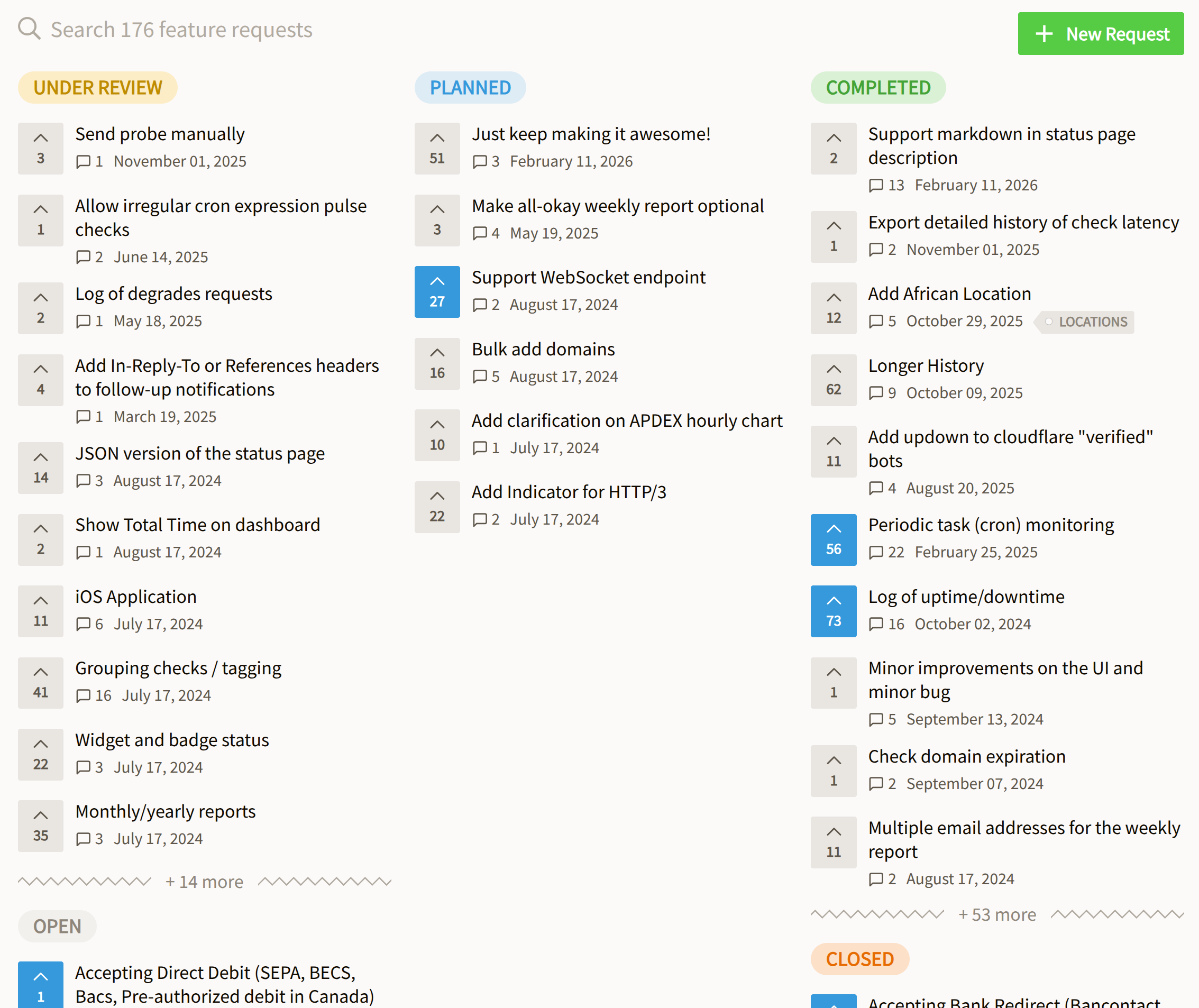
You can expect this one to stay (and evolve) for as long as updown.io will exist 👴
Please have a look, cast your votes and/or add your own suggestions. It's likely not perfect yet but it's more than enough to get the message.
Bonus
I also took this opportunity (as I needed to implement comments) to share the comments feature with this very blog, that's the beauty of having everything in the magestic monolith :) So you can now comment under each blog articles in addition to on the feature board.

3 Comments
You should spin-off this feature and call it upvote.io and we will use it ;-)
Haha, I thought about this at some point, but I have enough work already :)
I deeply love the new feature board!!
It's so much simpler and more ergonomic!!
Congratulations!!
Honestly that would be a really great thing to open source one day when you have the time, I've been looking for a great, no-bullshit solution for tracking feature requests and this would be perfect!!
Sign in to comment